

Introduction
You want to scale your income in high-ticket sales. You’ve mastered the one-on-one close, but hitting a ceiling. Growing beyond your own daily effort feels like the next big leap, but how?
This is where channel sales changes everything.
Simply put, channel sales is a growth strategy where you sell your product or service through partners, rather than just directly to customers yourself. These partners, like agencies, resellers, or other businesses, become an extension of your sales force. For a high-ticket sales professional, it’s the key to building a scalable, leveraged income model that isn’t limited by your own time.
However, it’s not as simple as just finding a partner. Many experts like you hit a wall. The guidance is often vague. The market is full of noise, making it hard to spot a real opportunity from a dud. Terms like “direct sales agency,” “alliances,” and “B2B sales ecosystems” get thrown around, adding to the confusion. You might wonder where to even start or how to build trust in a system that seems complex.
Here’s the good news. The channel market isn’t just a concept; it’s a massive, growing engine. Research projects it is experiencing robust growth, with a compound annual growth rate of 8.50% according to a 2025 market report.

Furthermore, digital marketplaces within the channel are becoming essential, with 90% of IT solution providers expecting a rise in marketplace sales by 2029 as reported in a 2024 industry survey.
This guide is your clear path through that complexity. We’ll move past the buzzwords to give you an evidence-based, practical framework. You’ll learn how to identify the right channel strategies, build profitable partnerships, and establish yourself as a trusted expert in this high-growth space. Whether you’re looking to understand the foundational commercial sales landscape or you’re actively figuring out how to break into high-ticket sales with a scalable model, this is your start. Let’s build your channel sales expertise.
What Are Channel Sales? Core Definitions and Key Concepts
Let’s start with the basics. Channel sales, also called indirect sales, is a growth model where you sell your offerings through third-party partners. Think of it like this: instead of you knocking on every single customer’s door, you work with other businesses that have their own doors already open. They sell your product or service to their clients, and you share the revenue.
This is very different from a direct sales agency approach where you or your internal team does all the selling directly to the end customer. The core dynamic shifts from "I sell" to "we sell through partners."
So why is this such a big deal for your sales strategy? The value proposition for high-ticket sales is powerful.
First, it gives you extended reach. Your partners have their own established customer bases and networks you could never access on your own. This lets you scale far beyond your personal capacity.
Second, partners bring localized expertise. A good partner understands their specific market or industry niche deeply. They know how to position your high-value offering in a way that resonates with their clients, which builds trust and closes deals faster.
Third, it can be more cost-efficient. While you share revenue, you avoid the massive upfront cost of building a huge direct sales team in every region or vertical. The channel market itself is a testament to this model’s power, projected to grow at a strong rate of 8.50% annually according to market research.
Now, let’s clarify the common terms you’ll hear. These are your potential partners:
- Resellers: They buy your product and sell it under their own brand or alongside their services. They own the customer relationship.
- Distributors: They act as a middleman warehouse, buying in bulk from you and selling smaller quantities to resellers or retailers. They handle logistics.
- Affiliates: They promote your product for a commission on each sale they refer. They typically don’t handle the actual transaction.
- OEMs (Original Equipment Manufacturers): They embed your product or technology into their own larger product before selling it.
Understanding this partner lifecycle from recruitment to joint selling is key. It’s also why foundational knowledge in commercial sales is so helpful before diving in. The entire ecosystem is evolving quickly, with digital marketplaces becoming essential engines for growth as industry reports indicate.
In short, channel sales turns your business from a solo act into a symphony, where each partner plays a part in reaching a much larger audience.
Primary Channel Sales Models: Structures for High-Ticket Success
Now that you know what channel sales is, let’s look at how it’s actually built. Choosing the right structure for your channel sales strategy is like picking the right tool for the job. Each model has its own superpowers and best uses.
Here are the three main frameworks you’ll see in the wild, especially for high-value, complex sales.
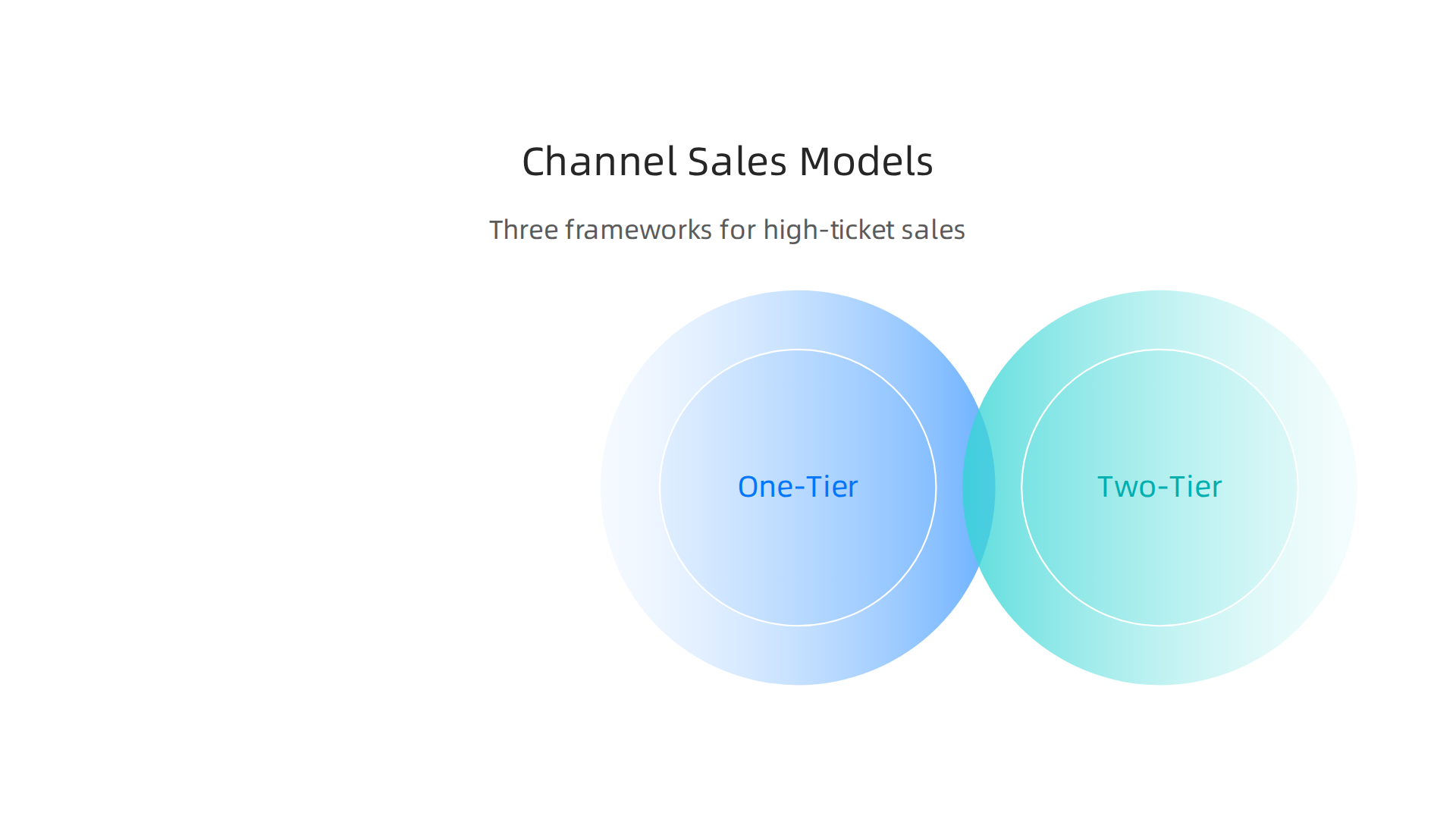
The One-Tier (Direct Partner) Model: Keep It Simple
This is the most straightforward model. You, the manufacturer or creator, sell your product directly to a partner business, like a reseller or a consultant. That partner then sells it directly to their end customer. You have a direct relationship with your partner.
- How it works: You → Reseller → End Customer.
- Best for: When you want close control over partner relationships and training. It’s common when partners are adding your software or service into their own offering for clients. It keeps the chain short and communication clear.
- The dynamic: You support a smaller number of partners deeply. They become an extension of your sales team. This model is a solid foundation for any B2B sales partnership.
The Two-Tier Model: Scale Through Distribution
This is the classic model for moving physical products or reaching vast, fragmented markets. You add a key player in the middle: the distributor.
- How it works: You → Distributor → Reseller → End Customer.
- Best for: Scaling rapidly across wide geographic areas or diverse industries. The distributor acts as your logistics and credit arm, holding inventory and selling smaller quantities to many different resellers. This lets you tap into a massive network without managing thousands of tiny relationships yourself. As noted in channel strategy discussions, the two-tier distribution model is a staple framework for manufacturers looking to expand their reach efficiently.
Hybrid Models & Strategic Alliances: The Best of Both Worlds
Here’s where modern sales strategy gets interesting. Most companies don’t use just one model. They blend them.
A hybrid model means you might sell directly to some large enterprise customers while also using a network of partners for smaller businesses or specific regions. This approach can be incredibly powerful. In fact, modern analysis shows that hybrid sales drives up to 50% more revenue than single-model approaches when done correctly. The trick is managing it so your direct sales team and your channel partners don’t compete for the same customer.
Then there are strategic alliances. This goes beyond a simple reseller agreement. Think of it as a joint venture for complex, high-ticket solutions. For example, a cybersecurity software company might form a deep alliance with a major cloud provider. Together, they create a bundled, certified solution that’s marketed as one seamless package. This is common in enterprise tech, consulting, and other fields where the combined offering is far more valuable than the parts.
Why choose a complex model? Because the market demands it. Modern buyers interact through multiple touchpoints. Adopting a multi-channel approach isn’t just an option; it’s how you meet customers where they are and build a more resilient business. For a deeper look at the foundational skills needed to navigate these complex sales environments, check out our 2026 guide to commercial sales.
So, which model is right for you? It depends on your product, your goals, and how much control you want. Start by asking: Do I need deep, direct partnerships? Massive, scaled distribution? Or a smart blend of both? Your answer will point you toward the right structure for your channel sales success.
Choosing the Right Model: Alignment with Product and Market
You know the main models now. So how do you pick the right one for your business? It’s not about which one sounds coolest. It’s about matching the model to what you’re selling and who you’re selling to. Think of it like choosing shoes for a hike. You need the right fit for the terrain.
Here are the four key factors to weigh when building your channel sales strategy.
1. Product Complexity
Is your product simple to explain and use? Or is it a complex, high-value solution that needs expert installation and hand-holding? Simple products can fly through a two-tier distributor network. Complex, high-ticket products often need the added support and trust of a strategic alliance or a skilled direct sales agency. These partners don’t just move boxes; they provide the consulting and integration the customer needs to buy.
2. Target Market Maturity
Is your market brand new, or is it well-established? In a new market, you might need to sell directly or through tight one-tier partnerships to educate everyone. In a mature market with lots of buyers, you need scale. That’s where the classic two-tier model shines, letting a distributor reach thousands of resellers you could never manage alone. As industry analysis notes, a two-channel strategy is key to success because it maximizes your reach and meets different customer preferences.
3. Required Support Level
How much help will your partners need? If they need constant training, marketing materials, and technical support, a one-tier model lets you control that quality. If you want partners who are already experts and need less hand-holding, a broader two-tier network can work. Your sales strategy must account for the cost and effort of supporting your channel.
4. Desired Control
Do you need to know every end customer’s name? Or are you okay with your product being one of many on a distributor’s shelf? One-tier models offer high control. Two-tier models offer less direct control but much greater scale. Many companies find a middle ground with a hybrid approach. Modern data shows that hybrid sales drives up to 50% more revenue than single-model approaches, because it balances control with coverage.
For high-ticket B2B sales, gross margin is your best friend. You need enough profit in each sale to split it with your partners and still make money. That high margin is what funds the partner incentives, training, and support that make complex channel partnerships work. It’s what turns a simple reseller into a true advocate for your solution.
Your choice shapes everything. Start by getting honest about these four factors for your own product. That clarity is the first step to building a channel that doesn’t just move products, but builds a lasting market for them. For more on the skills needed to sell in these complex, high-value environments, explore our guide on how to break into high-ticket sales.
Building a Winning Channel Sales Strategy: A Step-by-Step Framework
Choosing the right model is your blueprint. Now, it’s time to build. A winning channel sales strategy doesn’t happen by accident. It’s built piece by piece, with clear phases that turn partners from casual sellers into powerful extensions of your own team. Think of it like coaching a sports team. You need to recruit the right players, train them on the playbook, and then track their stats to help them improve.
Here is a simple, three-phase framework to build your strategy for 2026 and beyond.
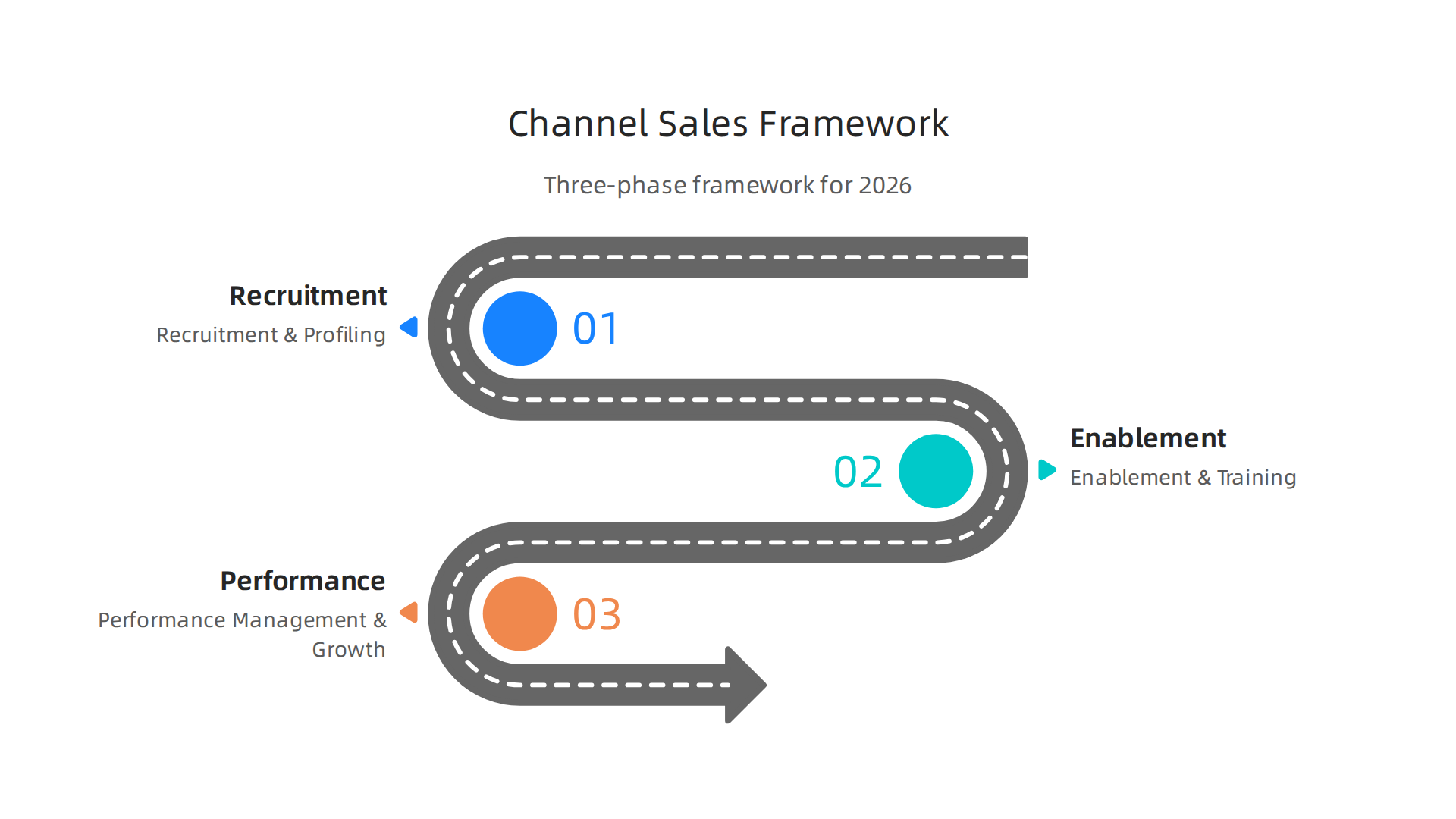
Phase 1: Partner Recruitment & Profiling – Find the Right Players
Your first job is to find the right partners. This isn’t about signing up everyone who shows interest. It’s about being selective and finding partners whose goals, markets, and capabilities align with yours.
- Look Beyond Just Revenue: A partner with a huge salesforce might seem perfect. But do they sell to your ideal customer? Do they have experience with your type of product? For a complex B2B sales solution, you need a partner who can provide consulting, not just processing orders. Profile them on their technical skills, customer relationships, and market reputation.
- Define Clear Criteria: Create a scorecard. What are your non-negotiables? It could be a minimum certification for their staff, a commitment to joint business planning, or a proven track record in your industry. Starting with the right fit prevents countless headaches later.
- Onboard with Intent: A smooth onboarding process sets the tone. Introduce them to your team, provide clear contracts and program guides, and establish open lines of communication from day one. A strong start builds trust and momentum.
Phase 2: Enablement & Training – Arm Them for Success
Once you have the right partners, you must empower them to win. This is called partner enablement. As defined by experts, partner enablement is the process of equipping partners with the tools, resources, and training needed to sell and support a company’s products.
It’s the core of your sales strategy.
A great enablement program includes:
- Product & Sales Training: Don’t just send a datasheet. Create interactive training on why your product wins, not just what it does. Include competitive battle cards and common objection handlers.
- Marketing & Sales Tools: Give them ready-to-use content like email templates, social media posts, case studies, and demo scripts. A strong program provides partners with what they need to improve lead generation and extend your marketing reach.
- Co-selling Support: Especially for new or complex deals, be ready to jump on a joint call with the partner and the prospect. Your expertise boosts their confidence and closes the deal faster.
The goal is to make selling your product easy and profitable for them. A well-designed program, as channel experts note, empowers your partners to market and sell your products effectively.
Phase 3: Performance Management & Growth – Coach to Win
You’ve recruited and trained your team. Now, you need to manage the game. This phase is about measurement, communication, and scaling what works.
- Set Clear KPIs (Key Performance Indicators): What does success look like? It’s more than just total revenue. Agree on metrics like sales pipeline growth, deal velocity, training completion rates, and customer satisfaction scores. As noted in industry best practices, KPIs offer valuable data points to evaluate and guide your partners.
- Communicate Regularly: Hold consistent business reviews. Discuss what’s working, what’s not, and where they need help. Use a shared dashboard so everyone sees the same numbers. Transparency builds alignment.
- Manage Conflict Fairly: Channel conflict (like two partners chasing the same deal) will happen. Have a clear, written rule of engagement for lead registration and territory to resolve issues fairly.
- Incentivize and Grow: Reward top performers with higher margins, spiffs (special performance incentives), or marketing development funds. Identify your star partners and invest in growing those relationships into deeper strategic alliances. For insights on managing the commercial relationships that drive this growth, our 2026 guide to commercial sales offers valuable perspective.
Building a channel is a marathon, not a sprint. By following this framework—recruiting the right partners, enabling them completely, and managing performance with data—you build more than a channel sales network. You build a scalable, predictable growth engine for your business.
Channel Sales Compensation and Career Paths: What Professionals Earn
After learning how to build a channel strategy, you might be wondering about the people who make it work. What does a career in channel sales actually pay, and where can it lead? Whether you’re considering a move into this field or planning how to compensate your own team, understanding the earning potential and career ladder is key.
Let’s break down the numbers and paths for 2026.
How Channel Sales Professionals Get Paid
Compensation in channel sales is designed to reward both individual effort and team leadership. It’s typically a mix of guaranteed and variable pay.
- Base Salary + Commission: This is the most common model. You receive a reliable base salary, plus a commission based on the sales revenue generated through your managed partners. This balances stability with performance incentives.
- Overrides: As a Channel Sales Manager, you might earn an "override" a percentage of the total sales made by all the partners in your territory or program. This rewards you for building and leading a successful network.
- SPIFFs (Special Performance Incentive Funds): These are short-term bonuses for achieving specific goals, like launching a new product with partners or signing a strategic partner in a key region.
Earning Potential: What the Numbers Say for 2026
So, what can you actually earn? Data from 2026 gives us a clear picture.
For individual contributors, like Channel Sales Representatives, earnings have a wide range based on experience and performance. Recent data shows that salaries for Channel Sales Representatives in the US range from around $19,000 to over $175,000, with an average near $42,000.
With more experience, this climbs significantly. For example, a Channel Sales Representative with over seven years of experience can have a base salary exceeding $130,000.
Management roles command higher compensation. In 2026, the average salary for a Channel Sales Manager is reported to be $85,182. With bonuses and overrides, experienced managers at this level often see total compensation packages that reach into the $120,000 to $150,000 range.
Channel Sales vs. Direct Sales: Where’s the Money?
A common question is whether you can earn more in direct sales or channel sales. In high-ticket domains, top direct sales closers can have uncapped commission potential on single deals. However, channel sales offers a different kind of leverage. Instead of closing one deal at a time, you enable an entire network to sell for you. Your earning potential scales with the success of your partners. While a direct sales ace might have higher peak earnings, a successful Channel Manager builds a more predictable, scalable income stream by managing a portfolio of partner-driven revenue. For a deeper dive into commercial selling, our 2026 guide to commercial sales explores related compensation models.
Climbing the Ladder: A Clear Career Path
A career in channel sales offers a structured and rewarding progression.
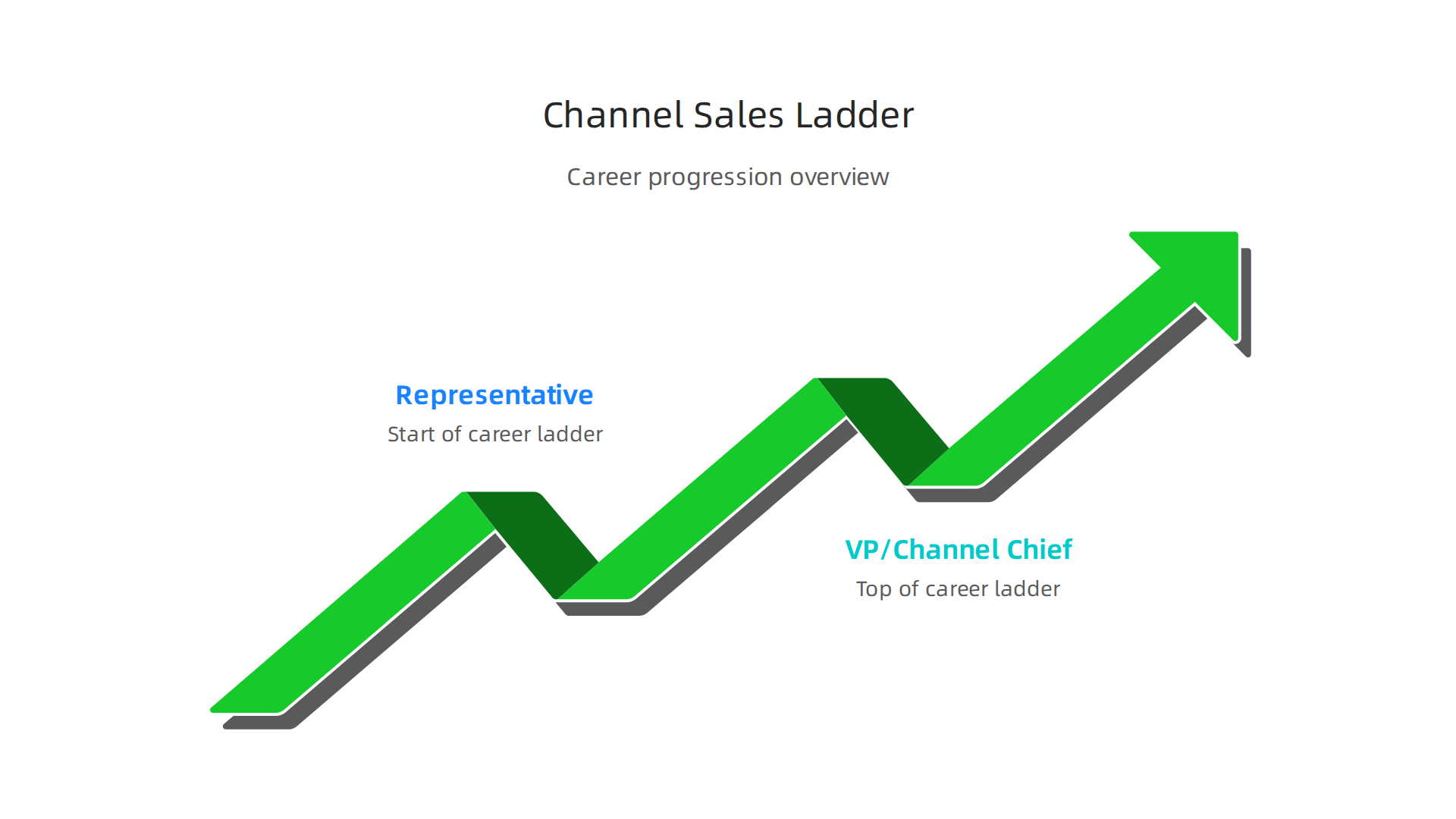
- Channel Sales Representative / Account Manager (Individual Contributor): You start by managing a handful of partners. Your job is to enable them, drive joint sales activities, and hit quota. This role builds crucial relationship and strategic skills.
- Senior Channel Manager / Regional Manager: With success, you take on more partners, a larger territory, or more complex partner types (like strategic alliances). You are now a seasoned player coaching newer reps and shaping strategy for your region.
- Director of Channel Sales: At this leadership level, you own the entire channel sales strategy for a product line or region. You set the program goals, define recruitment criteria, manage the budget for partner incentives, and lead a team of managers.
- VP of Channels / Channel Chief: This is the top of the ladder. You report directly to the CRO or CEO and are responsible for the global channel vision. Your role is fully strategic, focusing on building the partner ecosystem as a primary growth engine for the entire company.
Whether you’re drawn to the relationship-building aspect or the strategic leverage of scaling through partners, channel sales offers a compelling and lucrative career path with clear steps for growth. If the high-earning potential of sales leadership intrigues you, learn more about the mindset and support systems needed in our article on the great life membership and high-ticket sales support.
Channel Sales vs. Direct Sales: A Strategic Comparison for Your Career
Now that you see the earning potential, you face a classic career choice. Should you go the direct sales route or build a career in channel sales? Both are core to B2B sales, but they play very different games.

Think of it this way. Direct sales is a solo sport. Channel sales is a team sport where you coach the players.
Here is a quick comparison to show the core differences.
| Aspect | Direct Sales | Channel Sales |
|---|---|---|
| Primary Role | Close deals yourself with end customers. | Enable and motivate partners to close deals. |
| Control | High. You manage the entire sales cycle. | Lower. You influence through partners. |
| Reach & Scale | Limited to your own effort and time. | Massive. You leverage entire partner networks. |
| Sales Cycle | Often faster, direct to customer. | Often longer, requires partner alignment. |
| Key Skill | Closing, direct persuasion, handling objections. | Relationship management, enablement, strategy. |
| Income Model | Often higher individual commission potential. | Scalable base + overrides on partner network revenue. |
The Direct Sales Path: Control and Speed
In direct sales, you own the relationship from the first hello to the signed contract. You’re the quarterback, the pitcher, and the scorer all in one.
The Good:
- You’re in Control: You manage your pipeline, your messaging, and the pace of the deal. Your success is directly tied to your effort.
- Direct Customer Connection: You build deep relationships with buyers and get immediate feedback. The wins feel very personal.
- Potentially Faster Commissions: When you close a deal, your commission is typically clear and timely. For high performers, this can mean significant, rapid earnings.
The Challenge:
- Limited Reach: There are only so many hours in a day. Your growth is capped by your personal capacity to find and talk to leads.
- Higher Cost of Acquisition: Finding and convincing new customers on your own is often more expensive and time-consuming for the company.
If the thrill of the direct close excites you, our 2026 guide to commercial sales delves deeper into that world.
The Channel Sales Path: Leverage and Scale
Channel sales flips the script. Instead of selling to customers, you sell through partners. Your job is to equip a direct sales agency or other partners with everything they need to sell for you.
The Good:
- Unmatched Scale: A single successful partner can have dozens of sales reps. Your effort is multiplied across their entire team. As noted in channel enablement strategies, this is key to extending your marketing reach and growing indirect sales.
- Partner Expertise: You tap into your partners’ existing customer relationships and market knowledge. They open doors you couldn’t on your own.
- Predictable, Scalable Income: You build a portfolio of partner-driven revenue. As your partner network grows and becomes more effective, your overrides create a steady, scaling income stream.
The Challenge:
- Less Direct Control: You must influence and persuade your partners to prioritize your product. You can’t force them to sell.
- Potential for Conflict: Partners may sell competing solutions or not follow your preferred process.
- Longer Setup Time: Building a productive partner relationship and seeing the first major deal can take months of investment.
Which Career Path is Right for You in 2026?
Your choice depends on your personality, skills, and goals.
Choose Direct Sales if:
- You love the adrenaline of closing a deal yourself.
- You are highly self-motivated and prefer to control your own destiny.
- Your strength is in direct persuasion, handling objections, and quick thinking.
- Your primary goal is to maximize individual earning potential on a deal-by-deal basis.
Choose Channel Sales if:
- You get energy from teaching, enabling, and building strategic relationships.
- You are a patient strategist who enjoys playing the long game.
- Your skills lean towards communication, project management, and influence.
- Your goal is to build a scalable, management-oriented career where your success is multiplied through others.
Both paths offer rewarding and lucrative futures in B2B sales. The best sales strategy for your career is the one that aligns with how you naturally work and what you want to build. Ready to start your journey in either field? Explore our foundational guide on how to break into high-ticket sales in 2026 for your first steps.
The Future of Channel Sales: 2026 Trends and Predictions
You might think channel sales is all about old-school relationships and phone calls. Actually, the game has changed completely. In 2026, it’s a high-tech, strategic field where the rules are being rewritten. The strategies that worked a few years ago just don’t cut it anymore.
Here’s what’s shaping the future for channel professionals right now.
1. Technology Integration: AI is Your New Co-Pilot
Forget clunky spreadsheets and manual follow-ups. The biggest trend is the full embrace of intelligent tools. We’re talking about AI-powered Partner Relationship Management (PRM) platforms that do more than just track deals.

These systems now analyze data to predict which partners are most likely to succeed, automate training, and even suggest the next best action for a struggling direct sales agency rep. As experts note, AI is shifting from a simple tool to an autonomous agent that manages workflows and supports partners in real time. This technology translates operational noise into clear, actionable steps, making your entire partner network smarter and more efficient.
2. The Shift to Partner Ecosystems: From Transactions to Co-Innovation
The old model was simple. You gave a partner a product and a price list. Today, that’s not enough. The trend is toward deep, integrated ecosystems.
Partners aren’t just resellers anymore. They are co-innovators. Your sales strategy must focus on building joint solutions and shared goals. This means working together on marketing, developing custom service offerings, and sharing data openly. However, this shift also brings pressure. Vendors are demanding more scale and sophisticated services from their partners. Smaller partners may face intensified threats as market demands increase. Your job will be to guide your partners through this evolution, helping them grow and specialize to stay competitive.
3. Impact on Skills: The New Channel Sales Pro
What does this mean for your career? The skill set for success in channel sales is evolving.
- You must be tech-savvy. Mastering digital enablement tools and data analytics platforms is non-negotiable. You need to interpret dashboards that show partner health and campaign performance.
- You must be an ecosystem strategist. It’s less about managing a single relationship and more about orchestrating a network. You need to understand how different partners complement each other to build a complete solution for the end customer.
- You must be a coach and consultant. With AI handling routine tasks, your value lies in high-level guidance. You’ll help partners develop their B2B sales strategies, navigate new technologies, and transform their own businesses.
The channel is becoming more intelligent, interconnected, and demanding. Staying ahead means embracing these tools and shifting your mindset from manager to strategic architect. Ready to future-proof your sales career? Start by building a strong foundation with our 2026 guide for beginners on how to break into high-ticket sales.
Summary
This article explains channel sales as a scalable growth strategy for high-ticket offerings, showing how selling through partners unlocks reach, localized expertise, and cost efficiency beyond direct selling. It defines core partner types (resellers, distributors, affiliates, OEMs), compares the main models (one-tier, two-tier, and hybrid), and gives a practical three-phase framework—recruitment, enablement, and performance management—to build a reliable partner network. You’ll also get guidance on choosing a model based on product complexity, market maturity, support needs, and control, plus compensation benchmarks and clear career paths in channel roles. The guide closes with a direct comparison to direct sales and forward-looking trends for 2026, such as AI-driven PRM, partner ecosystems, and the evolving skill set channel professionals need to succeed.